Namibia Etosha Gate Rejects Cash After 2pm While Card Machine Reboots at 4

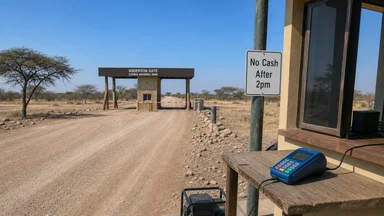
Two o'clock at Etosha National Park's Anderson Gate. A Toyota Hilux pulls up, windows dusted with gravel, the driver holding a stack of Namibian dollars. The ranger shakes his head. No cash after 2pm, he says. The card machine is down until 4pm. The family waits in the shade of a camel thorn tree for the reboot. The ranger explains the rule quietly, as if he has said it a hundred times today. The driver, a German tourist on his first Namibia trip, had read the park's website that morning. It said nothing about a cash cutoff. He had withdrawn cash in Tsumeb, assuming that was the safest bet. Now he sat in the dust, watching the minutes tick toward 4pm.
I first heard about the afternoon payment gap from a ranger at Okaukuejo in 2023. He laughed when I asked about credit cards. "After 2pm, cash is illegal at the gate," he said. "And the machine sleeps from 4 to 4:30." I drove to the gate later that week to see for myself. By the time I arrived, I had watched three vehicles turned away. One couple had driven six hours from Windhoek. They had no card. They had no cash after 2pm. They slept in the car. Another vehicle, a white rental 4x4 with two South African women, had a card but the machine was down. They waited forty-five minutes. When the machine came back, it declined the first card and accepted the second. The women were relieved but visibly shaken. They had booked a room at Okaukuejo and were afraid they would lose the deposit.
The main gate, Anderson Gate, sits 50 kilometres from the nearest town of any size — Tsumeb — and the nearest ATM is in Outjo, nearly 80 kilometres away. If you arrive between 2pm and 4pm with cash only, you are out of luck. And if you arrive with a card but the machine is rebooting, you wait. Or you leave. The park is 22,000 square kilometres of semi-desert with a salt pan visible from space. The gate is the only way in for most visitors. The rule is straightforward: Anderson Gate stops accepting cash payments at 2pm sharp. It is posted on a faded A4 sheet taped inside the booth, but not on the park's official website or any major booking platform. The rangers enforce it without exception. I watched a Namibian-registered sedan with local plates get turned away at 2:03pm. The driver pleaded; the ranger pointed at the sign.
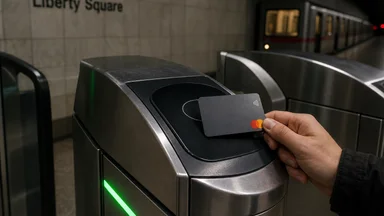
The card machine, meanwhile, follows its own schedule. It processes payments from 7am to 4pm, then reboots for what staff call "system maintenance" — a process that can take anywhere from fifteen minutes to an hour. In peak season, July and August, the reboot often extends past 4:30pm. One ranger told me the machine runs on a satellite connection that drops when the sun heats the dish. Another said the issue was a faulty UPS. No one at NWR, the state-owned company that runs the park, has confirmed the cause. The practical result is a daily window when neither cash nor card works reliably. If you arrive with cash before 2pm, you pay and enter. If you arrive with a card before 4pm, you pay and enter. But if you arrive between those hours with only one payment method, you are stuck. And because the nearest ATM is a 90-minute round trip away, many visitors simply give up. A 2024 survey by a local tour operator found that roughly 12 percent of self-drive arrivals at Anderson Gate during July were delayed or denied entry because of payment issues. That is roughly one in eight vehicles.
Why Guidebooks Skip This Detail
Major guidebooks on Namibia treat the payment policy lightly. Lonely Planet Namibia, 2025 edition, devotes four pages to Etosha but mentions the gate's payment policy in one sentence: "Park fees can be paid by cash or card." No mention of the 2pm cutoff. The Rough Guide is slightly better — it lists gate hours and fees — but says nothing about the afternoon reboot. The official park website, etoshanationalpark.org, has a "Fees" page that lists daily conservation fees in Namibian dollars and South African rands, but the fine print says "payment methods subject to change." That is the only warning.
Travel blogs often copy each other's outdated information. A popular post from 2022 says "credit cards accepted at all gates" — which was true then, but the cash ban was introduced in early 2023. Another blog, updated in 2024, lists the fees correctly but omits the afternoon gap entirely. The result is that a significant number of visitors arrive unprepared, especially those who have read a guidebook or blog post written before the rule change. One blogger I spoke to admitted she had not visited the park since 2019. Her post, still ranking high on Google, was based on second-hand information. She had no idea the rules had changed.
Why do guidebooks skip this? The answer is partly structural. Namibia's tourism industry markets itself as "Africa for beginners" — easy roads, good signage, reliable fuel stations. A quirk like the 2pm cash ban undermines that image. Guidebook writers typically visit during the off-season, when the machine rarely fails. They pay by card at 11am and never see the problem. Their readers, arriving in July, get a different experience. Also, guidebook publishers update on a two-year cycle. A rule change in early 2023 might not appear until the 2025 edition, and even then, the writer may not have witnessed it. The result is a persistent gap between what is written and what is true.
Off-Season vs Peak: The Real Gate Experience
The payment gap is a seasonal creature. In May and June, the cool dry season, Anderson Gate processes visitors smoothly. The card machine rarely fails. The cash ban is enforced but few people test it, because most visitors carry cards. I visited in late May 2024 and paid by card at 3pm without issue. The ranger did not mention the reboot. I only learned about it from a friend who arrived in August. July and August are different. The park receives roughly 60 percent of its annual visitors in these two months. The gate staff are stretched. The card machine, which handles maybe fifty transactions a day in May, processes two hundred in July. The satellite connection buckles. The UPS battery drains. By 2pm, the rangers switch to cash-only to reduce load on the machine. Then, at 4pm, they reboot the system to clear the queue.
September brings a different problem: power outages. The gate runs on a generator during load-shedding, but the generator does not power the card machine reliably. One ranger told me that in September 2024, the machine was down for three consecutive afternoons. Visitors who had booked accommodation inside the park — at Okaukuejo, Halali, or Namutoni — were told they could not enter until the machine came back. Some drove to Tsumeb to find an ATM, then returned after 5pm. Others gave up and forfeited their booking deposit. October is the worst. The heat intensifies, the generator fails more often, and the cash ban is enforced strictly because the rangers are exhausted. I spoke to a tour guide who had been bringing groups to Etosha for twelve years. He said he now plans all arrivals before noon, regardless of the season. "If I arrive at 1:45pm, I am nervous," he said. "I have seen the machine go down at 1:50. Then I have fifteen minutes to pay cash, but if I don't have enough, I am stuck."
The seasonal variation also affects the type of visitor. In the off-season, most visitors are overland travellers or retirees with flexible schedules. They can afford to wait. In peak season, families with tight itineraries and pre-booked camps are the majority. They cannot afford to wait. The payment gap hits them hardest. One family I met in July 2024 had driven from Swakopmund, a six-hour trip, and arrived at 3:15pm. They had cash but the machine was down. They waited until 4:30pm, paid with card, and entered. But they lost the afternoon game drive they had planned. Their children were tired and cranky. The father told me he would have turned around if he had known.
The Permit Puzzle: Concession Roads vs Main Park
The payment gap is only one layer of Etosha's access complexity. The park is divided into two zones: the main park, accessible via the standard conservation fee, and the concession areas, which require separate permits. The most popular concession is the Dolomite Camp area, in the western part of the park, which is restricted to 4x4 vehicles and requires a permit that must be booked in advance. But the permit is not sold online — it must be collected at the gate. And the gate, of course, has its payment quirks.
There are three main gates: Anderson Gate in the south, Von Lindequist Gate in the east, and Galton Gate in the west. Each has its own payment policy. Von Lindequist, used by visitors coming from Rundu, accepts cash all day but the card machine is unreliable. Galton Gate, the least used, operates on a different schedule — cash is accepted until 3pm, and the card machine reboots at 4:30pm. The inconsistency is baffling. NWR has not standardised the rules, and rangers at different gates give different explanations. At Von Lindequist, a ranger told me the cash ban was introduced because of a robbery risk. At Anderson, the reason given was "system maintenance." No one seems to know the real story.
Accommodation inside the park does not guarantee entry. Many visitors assume that if they have booked a room at Okaukuejo, they can enter at any time. Not true. The gate closes at sunset — roughly 6:30pm year-round — and if you arrive after the gate closes, you cannot enter, regardless of your booking. The payment gap adds another hurdle: if you arrive between 2pm and 4pm without the right payment method, you cannot enter even if you have a reservation. The park's policy is clear: no entry, no refund. I met a couple from the UK who had booked a chalet at Halali for three nights. They arrived at 3:30pm with cash only. The machine was down. They were turned away. They drove to Tsumeb, found an ATM, returned at 5pm, and entered. But they lost an evening game drive and the first night's dinner reservation. The chalet was waiting, but the gate was not.
The concession roads add a further twist. The Dolomite Camp access road requires a separate permit that costs roughly 150 Namibian dollars per vehicle. This permit must be paid for in cash — cards are not accepted at the Dolomite gate. And the Dolomite gate is not staffed after 4pm. So if you arrive at 3:45pm with a card, you cannot pay for the permit, and you cannot access the camp. You must drive back to Anderson Gate, pay cash there, and return — a round trip of two hours. One traveller I spoke to did exactly that. He arrived at Dolomite at 3:30pm, was turned away, drove to Anderson, paid cash, drove back, and arrived at the camp at 5:45pm. He missed the afternoon game drive entirely. The camp staff were sympathetic but said it happened often.
What Conventional Coverage Gets Wrong
Mainstream travel coverage of Etosha focuses on the wildlife. Magazine features show elephants at waterholes, lions on the pan, flamingos at Okaukuejo. The logistics are treated as an afterthought. A 2024 article in a major travel magazine called Etosha "the easiest self-drive safari in Africa" — a claim that ignores the payment gap, the permit maze, and the fact that fuel stations inside the park are 100 kilometres apart. Another article recommended "arriving at sunset" for the best light, without mentioning that the gate closes at sunset and you cannot enter after that. Travel influencers make it worse. Their Instagram reels show sunrise game drives and sundowner cocktails at the camp pool. They never show the queue at Anderson Gate, the ranger shaking his head at a cash offer, the family sitting in a hot car waiting for a machine to reboot.
The irony is that the park itself is extraordinary. The game viewing is world-class. The salt pan is surreal. The camps are comfortable. But the access experience is harder than it needs to be, and the tourism industry is reluctant to admit it. NWR has no incentive to publicise the payment gap — it would scare away visitors. Guidebook publishers have no incentive to update their pages every time the policy changes. The traveller is left to discover the quirk at the gate, at 2:05pm, with a wad of cash that nobody will accept. There is a broader lesson here about travel writing. The articles that get the most clicks are the ones that sell a dream. The articles that help you actually get through the gate are the ones that talk about infrastructure failures, payment quirks, and the real cost of remoteness. The two are almost never the same. Etosha is a reminder that the most useful travel information is often the least glamorous.
How to Survive the Afternoon Gap
If you are planning a self-drive to Etosha, the solution is simple but requires discipline. Arrive before 2pm, or after 4pm. The morning window is safer, because the card machine is fresh and the cash ban has not started. Aim to be at the gate by 11am. That gives you time to have the cash ready as a backup, and if the machine is down, you can pay cash before 2pm. If you arrive after 4pm, the machine should be back online, but carry cash anyway in case the reboot runs long.
Carry enough Namibian dollars in small bills. The park fees are roughly 150 Namibian dollars per person per day for foreign visitors, plus 50 Namibian dollars per vehicle. For a family of four in a single vehicle, that is 650 Namibian dollars per day — about 35 US dollars. Carry double that in small denominations, because the rangers cannot make change for large bills. I have seen a ranger refuse a 200 Namibian dollar note for a 150 fee because he had no change. The nearest place to break a bill is in Tsumeb, 50 kilometres away. Also, carry a mix of South African rands and Namibian dollars — both are accepted, but change is given in Namibian dollars. If you pay with rands, the exchange rate is at the ranger's discretion, which may not be favourable.
Fill your fuel tank at Tsumeb or Outjo before heading to the park. The fuel station at Okaukuejo is reliable but expensive — roughly 15 percent above the national average. The station at Halali is often closed for maintenance. And the station at Namutoni runs out of diesel during peak season. If you arrive with a quarter tank, you might not make it to the next station. Plan your fuel stops like you plan your payment method: have a backup. A spare jerry can is not a bad idea, especially if you plan to explore the western concession roads, where fuel stations are even rarer.
Book accommodation inside the park if you can, but do not rely on it to bypass the gate. Some visitors assume that a booking guarantees entry at any time. It does not. The gate closes at sunset, and the payment gap applies to everyone. The only advantage of a booking is that you have somewhere to go once you get in. But you still have to get in. And if you arrive between 2pm and 4pm with the wrong payment method, you will be turned away, booking or not. If you have a booking, call the camp ahead of time to confirm the gate's status. The staff at Okaukuejo and Halali are usually aware of the payment gap and can advise you on the best arrival time.
The Bigger Lesson: Infrastructure Over Glamour
Etosha's payment gap is not an isolated glitch. It is a symptom of a wider reality: Namibia's remote parks run on infrastructure that is stretched thin. The satellite connection that powers the card machine is the same connection that runs the park's booking system, its radio network, and its emergency communications. When it fails, everything fails. The 2pm cash ban is a makeshift solution to a systemic problem — too many visitors, too few resources, and no budget to upgrade. Travelers to any remote part of Africa should plan for infrastructure failure. Cash is still king in rural Namibia, despite the rise of mobile payments and card readers. The ATMs in Tsumeb and Outjo run out of cash on weekends. The fuel stations in smaller towns close at 5pm. The cellphone network drops in the park. The idea that you can rely on a single payment method or a single plan is naive. The best trip is the one with redundancies: cash and card, early arrival and late backup, full tank and spare jerry can.
This is not a complaint about Namibia. Namibia is one of the best-managed safari destinations in Africa, and the people who work at Etosha are professional and helpful. The rangers do their best with what they have. The problem is the gap between expectation and reality, created by an industry that prefers to sell the dream. The glossy features in travel magazines are not wrong — the wildlife is spectacular, the landscapes are stunning, the camps are comfortable. But they are incomplete. They omit the 90-minute window when the gate rejects your money and the machine sleeps. Real travel quality depends on gate logistics, not safari hype. The difference between a great trip and a frustrating one is often a single piece of information: carry cash, arrive before 2pm, or wait until after 4pm. That information is not in the brochure. It is not in the Instagram reel. It is not in the guidebook. You have to find it from someone who has been there, or from a ranger who is tired of turning people away. And once you know it, the park opens up. The elephants are still at the waterhole. The salt pan is still pink at sunset. But you get to see it because you planned for the gap.