One Trust Amendment That Gave Grantors Voting Power They Never Legally Held

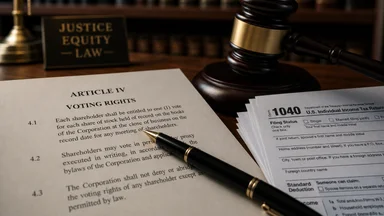
In the late 1990s, estate planning lawyers began adding a clause to grantor retained annuity trust (GRAT) documents that gave grantors the right to vote shares transferred into the trust. The idea seemed harmless: the grantor was already receiving annuity payments from the trust, so why not let them keep voting the stock? But this amendment, drafted by some of the country's best estate planning lawyers, set off a chain of IRS challenges and Tax Court rulings that ultimately rewrote the rules on when a grantor is treated as having retained control over trust assets. The story of this amendment is a cautionary tale about the tension between a client's desire for control and the technical requirements that make a trust work for tax purposes.
The Trust Amendment That Never Should Have Been Written
The grantor retained annuity trust, or GRAT, had become a popular estate planning vehicle by the mid-1990s. In a typical GRAT, the grantor transfers assets—often shares of a family business—to an irrevocable trust and retains the right to receive a fixed annuity payment each year for a term of years. At the end of the term, any remaining assets pass to beneficiaries, usually the grantor's children, with little or no gift tax. The key to the GRAT's tax efficiency is that the grantor is treated as having made a gift only of the present value of the remainder interest, which can be very small if the annuity is set high enough.
Standard GRAT documents gave the grantor no voting power over the transferred shares. The trustee, often a family member or a corporate trustee, held legal title and exercised all voting rights. This was by design: the grantor had to give up control to avoid the estate tax inclusion rules under IRC Section 2036. But clients, especially those who had built a business from scratch, hated handing over voting control to a trustee. They wanted to keep their hand on the wheel even after the shares were in the trust.
In the late 1990s, some law firms began adding a clause to GRAT documents that granted the grantor the right to vote the shares held in the trust. The reasoning was that the grantor was already receiving annuity payments, so retaining voting power was merely an incidental benefit, not a retained interest in the trust corpus. The IRS had not explicitly prohibited this practice, and for a few years, the amendment flew under the radar.
But the logic was shaky. The grantor was receiving annuity payments as a beneficiary, not as an owner. Voting rights, by contrast, are a quintessential attribute of ownership. By retaining the right to vote, the grantor was effectively keeping a string attached to the transferred property—a string that the IRS would eventually yank hard.
How the Amendment Quietly Shifted Asset Control
To understand why the voting amendment was so problematic, it helps to see how a GRAT works without it. In a standard GRAT, the grantor transfers assets to the trust and receives annuity payments for a set term. The trustee holds legal title and manages the assets, including voting any shares. The grantor has no say in how the shares are voted; that authority rests entirely with the trustee. This separation is critical because it means the grantor has not retained any right to the income or enjoyment of the transferred property.
The voting amendment recast the trustee's role as something closer to a custodian. The trustee still held legal title, but the grantor directed how to vote the shares. This arrangement gave the grantor de facto control over the trust's most important decisions—electing board members, approving mergers, setting dividends—without any of the legal ownership that normally accompanies such power. The grantor could continue to run the family business as if nothing had changed, even though the shares were nominally owned by the trust.
This arrangement created a tension that tax lawyers recognized but underestimated. Under IRC Section 2036, if a grantor retains the right to designate who will possess or enjoy the trust property or the income from it, the trust assets are included in the grantor's gross estate at death. Voting rights over shares that carry the power to elect directors and control corporate policy can easily be seen as a retained right to designate enjoyment. The amendment, in effect, gave the grantor a backdoor way to retain control without formally retaining an interest—or so the drafters hoped.
The problem was that the IRS and the courts look at substance over form. If the grantor could vote the shares, the grantor could influence dividend policy, which in turn affected the annuity payments the grantor received. That circular logic made the voting right look less like a separate power and more like a retained interest in the trust's income or corpus. The amendment was a ticking time bomb.
The IRS Response: Notice 2003-99 and the Schutt Decision
The IRS fired its first shot in December 2003 with Notice 2003-99. The notice announced that the IRS would treat a grantor's retention of voting rights over shares transferred to a GRAT as a retained interest under Section 2036. This meant that upon the grantor's death, the full value of the trust assets—not just the value at the time of transfer—would be included in the grantor's gross estate. The notice was a bombshell for estate planners who had been using the voting amendment for years.
The Tax Court validated the IRS's position in the 2005 case Estate of Schutt v. Commissioner. The decedent, John Schutt, had transferred shares of Schutt Industries, a closely held manufacturing company, to a GRAT but retained the right to vote the shares. After his death in 1999, the IRS determined that the voting rights constituted a retained interest and included the trust assets in his estate. The Tax Court agreed, holding that the power to vote shares that control a corporation gives the grantor the ability to affect the trust's income and corpus, and thus constitutes a retained right to designate enjoyment. The court specifically noted that the voting rights allowed Schutt to influence dividend policy, which in turn affected the annuity payments he received from the GRAT. The trust assets, valued at approximately $1.5 million at the time of transfer, were included in Schutt's estate at their full date-of-death value, which was significantly higher due to business growth. The decision was a clear victory for the IRS and a stark warning to practitioners.
The Schutt decision had immediate and far-reaching consequences. GRATs that had been set up with the voting amendment were now at risk of having their assets pulled back into the grantor's estate. Families that had relied on the GRAT to remove appreciating assets from their estate tax base suddenly faced inclusion of the full date-of-death value. Some practitioners scrambled to amend their documents, but for trusts that had already been funded, the damage was done. The IRS began auditing GRATs that included the voting clause, and many families faced unexpected estate tax liabilities.
The Schutt ruling also created a split with some earlier cases that had allowed voting rights in certain contexts, but the Tax Court's reasoning was clear: voting power over shares that carry control over corporate policy is a retained interest, period. The amendment that had seemed like a harmless concession to client preferences had turned into a trap.
Why Advisors Kept Drafting the Amendment Anyway
Despite the clear warning from Notice 2003-99 and the Schutt decision, some advisors continued to include voting rights in GRAT documents for years afterward. Why? Partly it was client pressure. Business owners who had spent decades building a company were reluctant to hand over voting control even to a trusted trustee. They saw the voting amendment as a way to have their cake and eat it too: get the estate tax benefits of a GRAT while keeping operational control of their business.
Another factor was the perception that the IRS would never audit small GRATs. Many GRATs were set up with assets valued at a few million dollars or less, far below the threshold that typically triggers an audit. Advisors reasoned that even if the voting amendment was technically wrong, the odds of getting caught were low. This risk-reward calculation led many to include the clause as a standard feature, especially in model documents from large law firms that were widely circulated.
Some advisors tried to hedge their bets by using a grantor trust structure known as a "defective" grantor trust, where the grantor pays the income tax on the trust's earnings, effectively allowing the trust to grow tax-free. In these trusts, the grantor is treated as the owner for income tax purposes but not for estate tax purposes. Some argued that if the grantor was already paying the tax on the trust's income, allowing them to vote the shares was a logical extension. But the IRS rejected this reasoning, and the Schutt case made clear that the income tax treatment did not change the estate tax analysis.
Practitioner comments from the period reveal a mix of caution and defiance. In a 2004 article in the Journal of Taxation, one estate planner wrote that "the notice appears to sweep more broadly than necessary" and advised clients to consider alternatives. Another, in a 2006 Tax Notes piece, lamented that "the Schutt case has effectively killed the voting amendment for GRATs" but noted that some advisors were still using it in offshore trusts, hoping to avoid detection. The lesson is that the desire for control often overrides sound tax planning. Advisors who should have known better continued to draft the amendment because it was what clients wanted, and because the consequences—if they came at all—seemed remote. But for the families who were audited, the price was steep.
The Real Cost: Lost Tax Benefits and Retroactive Penalties
When the IRS recharacterized a GRAT with the voting amendment as a grantor retained interest, the estate tax inclusion was not limited to the value of the assets at the time of transfer. Instead, the full date-of-death value of the trust assets was included in the grantor's gross estate. For a GRAT that had been funded with shares of a rapidly growing company, the difference could be enormous.
Consider the real-world case of Estate of Schutt. John Schutt transferred shares of Schutt Industries, a manufacturing company, to a GRAT in 1995. The shares were valued at approximately $1.5 million at the time of transfer. By the time of his death in 1999, the company's value had grown substantially, though the exact figure was disputed. The Tax Court determined that the full fair market value at death—not just the original transfer value—was includible in his estate. Although the specific dollar amount was not publicly disclosed, the inclusion meant that the estate owed additional tax on the appreciation, effectively nullifying the GRAT's purpose. The estate also faced potential penalties under IRC Section 6662 for underpayment of tax attributable to a substantial valuation misstatement. In similar cases, penalties of 20% or more have been imposed, along with interest accruing from the original due date of the estate tax return. For some families, the total liability exceeded the value of the trust assets themselves, forcing them to sell assets to pay the tax.
The cost was not just financial. The process of an IRS audit of a GRAT can take years, during which the family's estate plan is in limbo. The trust may be unable to distribute assets to beneficiaries until the tax issue is resolved. And the emotional toll of having a carefully crafted plan undone by a single ill-advised clause is significant. The voting amendment turned what should have been a straightforward estate planning tool into a litigation nightmare.
Lessons for the Modern Trust Drafter
The voting amendment history offers several clear lessons for anyone drafting a GRAT today. First, never grant voting rights to the grantor unless there is explicit statutory authority or a specific ruling that permits it. The IRS has made its position crystal clear, and the Tax Court has upheld it. There is no gray area worth exploiting.
Second, use an independent trustee or a trust protector to handle voting decisions. The trustee should be someone who is not the grantor and who will exercise independent judgment. If the grantor wants to retain influence over the business, they can appoint a trust protector with limited powers, such as the ability to remove and replace the trustee, but not to direct voting. This gives the grantor a safety valve without crossing the line into retained control.
Third, consider using a spousal lifetime access trust (SLAT) or other structures that allow the grantor's spouse to benefit from the trust without the grantor retaining control. In a SLAT, the grantor transfers assets for the benefit of the spouse, and the spouse can receive distributions. The grantor does not retain any rights, so the trust assets are not included in the grantor's estate. This can achieve many of the same goals as a GRAT without the control issue.
Fourth, document the business purpose for any unusual provision. If a trust includes an unusual power, the drafter should write a contemporaneous memo explaining why it was included and why it does not constitute a retained interest. While this may not save the trust if the IRS challenges it, it can help in litigation by showing that the drafter considered the issue.
Finally, review existing GRATs periodically against current IRS rulings and case law. The tax landscape changes, and what was acceptable a decade ago may no longer be safe. A periodic review can catch potential problems before they become audit issues.
The Broader Principle: Form Over Substance Still Wins
The voting amendment story is a reminder that in tax law, form matters. The grantor who transfers assets to a trust must give up real control, not just legal title. The IRS and the courts will look past the form of the trust document to the substance of the arrangement. If the grantor retains the ability to direct the trust's voting, the grantor has not really given up control, and the trust will be treated as a grantor retained interest for estate tax purposes.
This substance-over-form doctrine is a fundamental principle of tax law. It prevents taxpayers from using technical structures to achieve results that are inconsistent with the underlying economic reality. The voting amendment was a textbook example of form over substance: the trust document said the trustee owned the shares, but the grantor still voted them. The Tax Court saw through the form and applied the substance.
The worst outcome for a trust with the voting amendment is that the IRS ignores the trust entirely for tax purposes. In that case, the grantor is treated as the owner of the assets, and the trust is disregarded. The estate tax benefits are lost, and the grantor's estate pays tax on the full value of the assets as if the trust never existed. The trust's beneficiaries receive nothing until the estate tax is paid.
The takeaway for anyone considering a GRAT is simple: let the trust do its job. The GRAT is designed to remove appreciating assets from the estate while the grantor receives annuity payments. If the grantor wants to keep control, a GRAT is the wrong vehicle. Other tools, such as a partnership or a voting trust, can provide control without the same tax consequences. But trying to retrofit control onto a GRAT is a recipe for disaster.