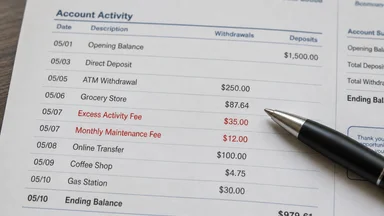
One Annuity Rider That Collects Fees on Money You Already Withdrew

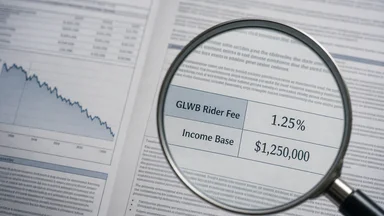
Variable annuities come with a long menu of optional riders, each promising to patch a specific retirement risk. The guaranteed lifetime withdrawal benefit (GLWB) is one of the most popular. It guarantees you can withdraw a certain percentage of a notional income base every year for life, regardless of what happens to the account value. It is marketed as a floor under your retirement income. But the fee structure buried inside many GLWB riders means you can end up paying an annual charge on money you have already taken out — and on growth that never really existed.
The Rider That Charges You for Money You Already Took Out
A GLWB rider calculates its fee based on the income base, not the actual account value. The income base is a separate, hypothetical number that starts with your initial premium, often gets a bonus of 5–10% upfront, and then grows at a guaranteed roll-up rate — typically 5% to 7% per year for a set period, often the first 10 years or until you start withdrawals. The account value, meanwhile, rises and falls with the underlying investments and is reduced by fees and withdrawals.
Here is the key twist: the rider fee is deducted from the account value, but it is calculated as a percentage of the income base. So if your income base is $200,000 and the rider fee is 1% annually, the insurer takes $2,000 out of your account value each year — even if the account value has dropped to $80,000. That $2,000 fee represents 2.5% of your actual cash, not the advertised 1%. The fee persists as long as the rider is in force, even after you have withdrawn most of the original principal.
Some contracts cap the rider fee at 1.5% of the income base per year, but that cap is on the percentage, not the dollar amount. And the fee is often layered on top of the annuity's base mortality and expense charge, administrative fees, and underlying fund expenses. The total annual cost of a variable annuity with a GLWB rider can easily run 3–4% of the account value in the early years, when the income base is largest relative to the account value.
Industry data from LIMRA's 2023 Individual Annuity Sales Survey indicates that roughly 60% of variable annuity contracts sold in the mid-2010s included a living benefit rider of some kind, with GLWBs being the most common. Yet surveys indicate that many buyers do not understand how the fee is calculated. A 2023 study by the Insured Retirement Institute, titled Annuity Owner Attitudes and Awareness, found that only about a third of annuity owners could correctly identify the income base versus account value distinction.
How the Income Base Inflates the Fee Pool
The income base is engineered to grow faster than the account value under most scenarios. Consider a typical contract: you invest $100,000, and the insurer adds a 5% bonus, giving you an initial income base of $105,000. Then a 6% annual roll-up applies for 10 years, compounding the income base to roughly $188,000 by the end of the roll-up period, assuming no withdrawals. Meanwhile, the account value depends on market returns and fees. If the underlying funds return 4% annually after fund expenses, the account value might grow to about $148,000 over the same decade — but that is before the rider fee.
The gap widens further if markets underperform. In a flat or declining market, the account value may stay near $100,000 or even fall, while the income base continues its mechanical climb. The rider fee, calculated on the larger income base, becomes an ever-heavier drain on the actual account. Some estimates put the typical income base at 20–40% above the account value after 10 years, depending on market conditions.
Withdrawals reduce the income base, but not proportionally. Most GLWB contracts reduce the income base by the dollar amount of each withdrawal, not by the percentage withdrawn from the account. So if you take a $10,000 withdrawal, the income base drops by $10,000 — but if the account value was only $80,000 at the time, that withdrawal represents 12.5% of the account, while it reduces the income base by only about 5% (if the income base was $200,000). The effect is that the income base shrinks more slowly than the account, keeping the fee base elevated.
After you begin withdrawals, the roll-up typically stops. But the income base may still be reset upward if the account value exceeds it on certain anniversary dates — a feature called a step-up. In rising markets, that can push the income base even higher, locking in gains that you may never realize in cash.
The Fine Print That Trips Up Retirees
One of the most misunderstood details is that the rider fee is deducted from the account value, not from the income base. That means the fee directly reduces the money you actually own. If the account value is low, the fee can consume a large fraction of the remaining cash. In extreme cases, the account value can fall to zero while the income base still shows a positive number — at which point the fee stops because there is nothing left to deduct, but the rider also becomes effectively worthless because there is no account to back the withdrawals.
Surrender charges compound the problem. Most variable annuities have a surrender period of 5 to 10 years, during which withdrawing more than the allowed free amount (usually 10% per year) triggers a penalty. If you decide to exit the annuity because the fees are too high, you may face a surrender charge of 6–8% of the account value. That can wipe out any remaining equity and lock you into the contract.
Market declines are another risk. If the account value drops sharply, the rider fee as a percentage of the account value spikes. For example, if the account value falls from $100,000 to $60,000 while the income base stays at $150,000, a 1% rider fee becomes a 2.5% effective charge on your actual cash. That can accelerate the depletion of the account, especially during a prolonged bear market.
Some newer contracts have addressed this by capping the rider fee as a percentage of the account value, or by using a lower roll-up rate. But many older policies still in force use the income-base method. A 2024 report from the Consumer Federation of America, Annuity Fees: A Consumer's Guide to Understanding Costs, highlighted that GLWB fees on in-force contracts averaged 1.15% of the income base, which translated to an effective cost of 1.8–2.5% of account value for policies with significant income base growth.
Why Insurers Love This Structure
From the insurer's perspective, the GLWB rider is a profit center. The fee stream is predictable and not directly tied to asset returns. Even if the underlying investments perform poorly, the insurer still collects the rider fee on the growing income base. The fee continues until the contract is surrendered, the account value hits zero, or the policyholder dies — and in many cases, the insurer collects fees for years before any withdrawal begins.
Actuarial models assume that a significant portion of policyholders will never take full advantage of the guarantee. Some will surrender early due to surrender charge concerns or changing needs. Others will die before exhausting the account value. The unused rider value — the difference between the income base and the actual withdrawals taken — reverts to the insurer. LIMRA data suggests that lapse rates for variable annuities with living benefits are about 3–5% annually, meaning many policies are surrendered within the first decade.
Profit margins on GLWB riders are estimated to be 20–30% above the cost of hedging the guarantee, according to actuarial studies from the Society of Actuaries. Insurers hedge the risk using derivatives, but the hedging cost is typically lower than the fee collected, especially when markets are calm. The difference flows to the insurer's bottom line.
Some critics argue that the structure creates a misalignment of incentives. The insurer profits most when policyholders pay fees for a long time without claiming benefits. That can lead to complex contract features that discourage early withdrawal, such as the income-base calculation that makes partial withdrawals less attractive. A 2022 paper in the Journal of Retirement, titled The Cost of Guarantees: GLWB Riders in Variable Annuities, suggested that the average GLWB policyholder would be better off with a simpler investment portfolio in roughly 40% of market scenarios.
One Real-World Case: A 65-Year-Old's Statement
To make this concrete, consider a simplified example based on common contract terms. A 65-year-old invests $100,000 in a variable annuity with a GLWB rider. The contract offers a 5% bonus on the income base and a 6% roll-up for 10 years. The rider fee is 1% of the income base annually. The underlying funds have an average expense ratio of 1% per year. The account value earns 4% gross, or 3% after fund expenses, before the rider fee.
After 10 years, the income base has grown to roughly $188,000. The account value, assuming no withdrawals, would be approximately $134,000 after fund expenses but before the rider fee. After deducting the rider fee each year (which compounds the drag), the account value is closer to $118,000. The rider fee alone has consumed about $16,000 over the decade.
Now the retiree starts taking withdrawals. The contract allows 5% of the income base per year, or $9,400 annually. The account value begins to decline. After five years of withdrawals, the account value might be around $80,000, while the income base has been reduced to roughly $141,000 (each withdrawal reduces it by the dollar amount). The rider fee is now $1,410 per year, which is 1.76% of the account value. The retiree is paying nearly 2% on actual cash for a guarantee that may never be needed.
If the market drops 20% in year 11, the account value could fall to $64,000, while the income base stays at $141,000. The rider fee becomes 2.2% of the account. The total expenses — fund fees plus rider — could exceed 4% of the account value annually, making it very difficult for the account to recover.
The Alternatives That Avoid Phantom Fees
Retirees seeking guaranteed income have other options that do not charge fees on a notional base. A systematic withdrawal plan (SWP) from a diversified portfolio of low-cost index funds and bonds can provide a steady income stream. The cost is just the fund expense ratios, typically 0.1–0.3% per year. The trade-off: no lifetime guarantee. If markets perform poorly or you live longer than expected, you may run out of money.
A single premium immediate annuity (SPIA) offers a true lifetime guarantee with no ongoing fees. You pay a lump sum, and the insurer sends you a fixed check each month for life. The cost is embedded in the payout rate, which reflects mortality credits. The downside: you give up access to the principal, and there is no inflation adjustment unless you buy a rider. But there are no annual fees to worry about.
Another alternative is a variable annuity without any living benefit riders. You get the tax deferral and the ability to invest in subaccounts, but you avoid the GLWB fee. The base contract still has mortality and expense charges, typically 1–1.5% annually, which is lower than the 2–3% total cost with a rider. You manage your own withdrawals, accepting market risk.
Self-insuring with a bond ladder and dividend-paying stocks can replicate some of the income guarantee without the fee structure. A ladder of Treasury bonds or CDs provides predictable cash flows for a set period, while dividend stocks offer growth potential. The cost is near zero, but you bear the risk of inflation and longevity. For some retirees, the peace of mind from an insurance guarantee is worth the fee — but the fee should be transparent and fair.
Another option that deserves attention is the deferred income annuity (DIA), also known as a longevity annuity. With a DIA, you pay a premium today and receive guaranteed income starting at a future date, often at age 80 or 85. There are no annual fees; the cost is embedded in the payout. The trade-off is that you have no access to the principal during the deferral period, and if you die before income starts, you may lose the premium unless a death benefit rider is purchased. For retirees who want to cover late-life expenses, a DIA can be a cheaper alternative to a GLWB rider because it avoids the ongoing fee drag on a notional base.
Finally, some retirees might consider a fixed indexed annuity (FIA) with a guaranteed lifetime withdrawal benefit. FIAs typically have lower base fees than variable annuities because they credit interest based on an index rather than investing in mutual funds. However, the GLWB rider on an FIA often uses a similar income-base structure, so the same phantom fee issue can arise. The key difference is that the FIA's account value does not decline with market downturns (it only misses upside), so the divergence between income base and account value may be less extreme. Still, the fee is calculated on the income base, and the same warnings apply.
What to Ask Before You Sign
If you are considering a variable annuity with a GLWB rider, ask the agent or advisor these specific questions. First: "Is the rider fee based on the income base or the account value?" If the answer is the income base, ask for a projection showing the dollar amount of the fee each year for the first 20 years, assuming a conservative market return.
Second: "Does the roll-up continue after I start taking withdrawals?" Most contracts stop the roll-up once withdrawals begin, but some allow it to continue for a period. That can increase the divergence between income base and account value.
Third: "What is the total expense ratio if I include the rider fee, the base contract fees, and the underlying fund expenses?" Ask for a single all-in number in dollars for the first five years. If the advisor cannot provide it, that is a red flag.
Fourth: "Can the insurer raise the rider fee in the future?" Some contracts allow the insurer to increase the fee with regulatory approval, though many are fixed. Check the contract language carefully. In 2021, a regulatory filing by Transamerica requested approval to raise GLWB fees by 0.25% on in-force policies, citing low interest rates. While that specific request may not have applied to all policies, it shows that fee increases are possible.
Finally, ask for a comparison with a simple portfolio of 60% stocks and 40% bonds, using a systematic withdrawal rate of 4% adjusted for inflation. Run both scenarios through a Monte Carlo simulation to see the probability of success. The GLWB may offer a higher probability of not running out of money, but at a cost that may not be justified for everyone.
Another useful check: read the fine print on how the income base is reduced by withdrawals. Some contracts reduce it by the dollar amount of the withdrawal; others reduce it by the proportion of the account value withdrawn. The latter is more favorable to the policyholder because it shrinks the fee base faster. Look for the phrase "proportional reduction" in the contract.
The GLWB rider is not inherently bad. For someone who wants a guaranteed lifetime income floor and is willing to pay for it, it can provide valuable protection against longevity and market risk. But the fee structure is opaque, and the cost can be much higher than it appears. Understanding the difference between the income base and the account value — and how that affects the fee — is essential before signing.
For related reading on how fine print can quietly erode financial products, see our earlier piece on mortgage recast clauses and the analysis of interest on paid balances.
This article is for informational purposes only and does not constitute personalized financial, legal, or investment advice. Consult a qualified professional before making decisions about annuity products.