Peru's Cruz del Sur Bus Network Skips Cusco Interchange After Dark

Most guidebooks describe Peru's long-distance bus network as comfortable, cheap, and punctual. The 2023 edition of Lonely Planet Peru calls it "a reliable way to cover big distances without flying." But they rarely mention that one of the country's largest operators, Cruz del Sur, refuses to run its southbound buses through Cusco after dark. The policy has been in place since at least 2019, but it still catches travelers off guard. A 14-hour ride from Lima to Cusco becomes a two-day affair with an unscheduled stop in Abancay, a mid-sized town in the Apurímac region that most passengers never intended to see. This article looks at how the rule works, why it exists, and what it means for anyone planning a week or two in Peru.
The Overnight Bus That Skips Cusco
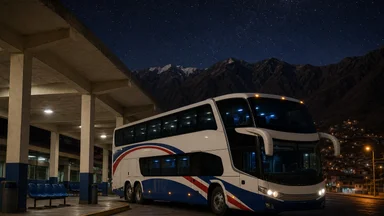
Cruz del Sur operates the most extensive intercity bus network in Peru, with a reputation for safety that is unmatched among domestic carriers. But that safety focus comes with a quirk: no southbound bus passes through Cusco after 8pm. Passengers booked on an overnight service from Lima to Cusco are instead dropped at Abancay or, on some routes, Andahuaylas. The final leg into Cusco departs early the next morning. The same logic applies to buses from Lima to Arequipa, which also stop in Abancay overnight.
The reason is straightforward. The road from Abancay to Cusco, and especially the stretch from Cusco to Juliaca, has a history of nighttime accidents. Local drivers say the route includes unlit curves, frequent rockfalls, and occasional fog. Cruz del Sur's corporate safety team decided that the risk was unacceptable after dark. A company statement in 2024 described the policy as "proactive risk management," though Peru's transport ministry does not mandate any such restriction.
Other bus companies, including Oltursa and Movil Tours, do run overnight services through Cusco. Cruz del Sur's approach is more conservative, and it shows in their accident record — consistently one of the best among Peruvian carriers, according to industry data (source: Peru's National Institute of Statistics and Informatics, 2023 report on bus accident fatality rates). But for the traveler, the trade-off is time. A journey that could be completed in a single night now stretches across two days and includes a forced layover in a town with limited tourist infrastructure.
The policy applies only to southbound services. Northbound buses from Cusco to Lima are not affected, presumably because the most dangerous stretches are south of Cusco. This asymmetry means that travelers heading from Cusco to Arequipa or Puno must plan for daytime departures, which can be inconvenient for those trying to maximize sightseeing hours.
How a 1,200-km Route Gets Broken Up
The classic Cruz del Sur route from Lima to Arequipa covers around 1,200 kilometers. Under normal conditions, the trip takes about 16 hours direct. But Cruz del Sur's policy splits it into two segments: Lima to Abancay (roughly 10 hours), then Abancay to Arequipa (another 8 hours). The first leg departs Lima in the early evening, arriving at Abancay's terminal around 4am. Passengers wait in a basic 24-hour waiting room until the connecting bus leaves at 5am. The second leg reaches Arequipa by early afternoon.
The same pattern applies for Lima to Cusco. The bus arrives in Abancay around 4am, and the onward connection to Cusco departs at 6am, arriving by midday. That means a passenger who boards in Lima at 8pm will not reach Cusco until noon the following day — a 16-hour journey that could have been 14 if the bus continued straight through. The extra time is spent waiting in Abancay.
Cruz del Sur's terminal in Abancay is not designed for extended stays. It has a small café, clean toilets, and a shop selling snacks and water. There is no luggage storage, no private lounge, and no hotel attached. Passengers who want to sleep must walk to one of the hostels near the terminal, which charge around US$8–12 a night. Most are basic but clean, with shared bathrooms and cold-water showers.
The forced stopover also affects luggage. Your main bag stays under the bus during the layover, so you cannot access it easily. A small daypack with essentials — toiletries, a change of clothes, a book — becomes essential. The bus company does not guarantee that your bag will be safe if you leave the terminal, though theft is rare.
What This Means for a 7-Day Peru Itinerary
A one-week trip to Peru is tight under any circumstances. Add a forced layover in Abancay, and the schedule becomes a puzzle. Here is how a typical week might look: Lima for two days, then a night bus to Abancay on day two. Day three is spent in Abancay — not because you want to, but because you have to wait for the onward bus. Day four arrives in Cusco by midday, leaving only three full days in the Sacred Valley before flying home.
That means two of seven days are consumed by the gap. A traveler who flies from Lima to Cusco (a one-hour flight, typically US$50–80) saves those two days and can spend them in Cusco or on a day trip to Machu Picchu. The bus-only traveler sacrifices a significant portion of their trip to the stopover.
For budget-conscious travelers, the bus is still cheaper than flying, even with the extra night in Abancay. A Cruz del Sur ticket from Lima to Cusco costs around US$30–40, while a flight is often double that. But the time cost is real. If your trip is only a week, the bus essentially forces you to choose between seeing Lima and seeing Cusco — you cannot do both without losing a day.
Some travelers try to game the system by booking with Oltursa or Movil Tours, which do run overnight buses through Cusco. Those operators are generally safe, but their safety records are not as strong as Cruz del Sur's. A 2023 accident involving an Oltursa bus on the Cusco–Juliaca road killed 17 people and injured 30 (source: Peru's National Institute of Statistics and Informatics, 2023 accident report). The decision to stick with Cruz del Sur or switch to a riskier operator is a personal one, but the trade-off is clear.
Why Cruz del Sur Enforces the Rule While Others Don't
Cruz del Sur's policy is not mandated by law. Peru's transport ministry sets minimum safety standards for bus companies, but it does not require any operator to avoid nighttime travel on specific routes. The decision is entirely Cruz del Sur's, and it reflects a corporate culture that prioritizes safety over convenience.
The company's accident record supports this approach. According to data from Peru's National Institute of Statistics and Informatics (2023 report), Cruz del Sur has one of the lowest fatality rates per passenger-kilometer of any major bus operator in the country. The company also invests heavily in driver training, vehicle maintenance, and real-time monitoring of road conditions. Its buses are equipped with GPS trackers, speed limiters, and driver fatigue sensors.
Other operators argue that the Cusco–Juliaca road is safe enough at night if drivers are properly trained and vehicles are well-maintained. They point out that many sections of the road have been improved in recent years, with better lighting and guardrails. Cruz del Sur's response is that no amount of improvement eliminates the risk of rockfalls, which are common in the Andes after dark.
Drivers who work for Cruz del Sur say the policy also reduces stress. One driver, who asked not to be named, told me that nighttime driving on the Cusco–Juliaca stretch is "like playing roulette" because of unlit curves and occasional livestock on the road. The company's refusal to risk it means drivers can rest overnight in Abancay and start fresh in the morning. That may be a small comfort to passengers who lose a day, but it is a real benefit for road safety.
Inside the Abancay Stopover: What to Expect
Abancay is not a tourist destination. The town sits in a valley at about 2,400 meters above sea level, surrounded by green hills and cloud forest. Its main attraction is the Mirador de Yanayacu, a viewpoint that overlooks the town and the surrounding mountains. It is worth a short walk if you have a couple of hours to kill.
The bus terminal is on the outskirts of town, about a 15-minute walk from the central plaza. The waiting room has plastic chairs, a television playing Peruvian news, and a small counter selling coffee and pastries. Toilets are clean but basic — bring your own toilet paper. There is no Wi-Fi, and mobile signal is patchy. Download offline maps and entertainment before you arrive.
If you decide to find a hostel, the best option is Hostal El Mirador, about 200 meters from the terminal. It charges around US$10 a night for a private room with a shared bathroom. The staff speak limited English, so basic Spanish helps. Several other hostels are clustered nearby, all in the same price range.
Food options near the terminal are limited to a few small restaurants serving Peruvian staples: rice, chicken, potatoes, and soup. A meal costs about US$3–5. The market in the center of town has fresh fruit and snacks, but it opens late. If you arrive at 4am, you will have to wait until 7am or 8am for the market to open. Pack a snack for the early hours.
The second leg of the journey departs at 5am or 6am, depending on the route. The bus from Abancay to Cusco is usually a semi-cama (semi-bed) service with reclining seats and air conditioning. The ride takes about six hours, including a brief stop at a roadside café for breakfast. The scenery is spectacular — the road climbs through cloud forest and past terraced hillsides — but the early departure means you may sleep through some of it.
Pacing a 14-Day Trip Around the Gap
With two weeks in Peru, the forced stopover in Abancay becomes less of a problem and more of a quirk. A sensible itinerary might look like this: Lima for three days, then a night bus to Abancay. Spend a day exploring Abancay's market and the Mirador de Yanayacu — it is not Machu Picchu, but it has a quiet charm. On day five, take the morning bus to Cusco and spend four days in the Sacred Valley. From Cusco, take a daytime bus to Arequipa (about 10 hours, departing early morning), then spend three days in the white city and two days visiting Colca Canyon. Return to Lima via Juliaca or fly from Arequipa.
Total bus time in this itinerary is roughly 30 hours over 14 days, which feels humane. The Abancay stopover breaks up the long Lima–Cusco journey and gives you a chance to see a part of Peru that most tourists skip. The town's altitude is lower than Cusco's, so it can serve as a gentle acclimatization stop before heading higher.
The Cusco–Arequipa leg must be done during daytime because Cruz del Sur does not run overnight services on that route either. That means leaving Cusco around 7am and arriving in Arequipa by late afternoon. The road passes through the altiplano and offers views of snow-capped volcanoes. It is a long day, but the scenery makes it bearable.
For travelers who want to include Lake Titicaca, the bus from Cusco to Puno takes about seven hours during the day. From Puno, you can cross into Bolivia or return to Arequipa. Cruz del Sur's daytime services on this route are reliable, but they fill up quickly — book a day in advance if possible.
The 14-day pace allows for rest days in Lima and Cusco, which helps with altitude adjustment and reduces the risk of burnout. It is not a checklist itinerary, but a realistic window into Peru's varied landscapes.
Packing for the Split: What You Actually Need
The forced layover in Abancay changes what you need to pack. A small daypack is essential for the overnight stop; your main bag stays locked in the bus's luggage compartment. In the daypack, include a warm layer — Abancay can drop to around 8°C after midnight, and the waiting room is not heated. A fleece or light jacket will suffice.
Toiletries are another must. The terminal has no showers, but some hostels near the terminal let you use their facilities for a small fee. Pack a travel towel, soap, and a toothbrush. Earplugs and an eye mask help if you try to sleep in the waiting room, which is lit and noisy.
Bring a reusable water bottle. The terminal's tap water is not potable, but there is a dispenser with filtered water for about US$0.20 per liter. Pack snacks for the early morning hours — the terminal café opens at 5am, but the selection is limited. Nuts, granola bars, and dried fruit are good options.
Offline maps are essential. Abancay's mobile signal is patchy, and the terminal has no Wi-Fi. Download Google Maps or Maps.me for the area before you leave Lima. Also download entertainment — podcasts, audiobooks, or movies — because the wait can be dull.
Finally, carry small denominations of Peruvian soles. The terminal café and nearby shops rarely accept credit cards, and ATMs in Abancay are unreliable. About 50 soles (roughly US$13) should cover food and incidentals during the stopover. Larger bills can be difficult to break, so bring coins and small notes.
The forced stopover is an inconvenience, but it is not a disaster. With the right preparation, it becomes a manageable part of the journey. The key question to ask yourself before booking: is saving US$20–40 worth losing a full day of your trip? For a week-long itinerary, the answer is often no. For two weeks, the stopover can be a quirky addition rather than a dealbreaker.