Bank Fine Print That Charges Interest on Your Paid Balance

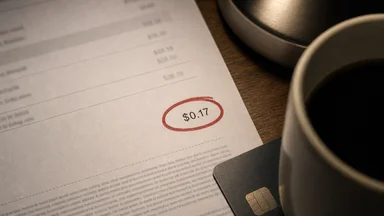
Paying your credit card balance in full each month is a cornerstone of personal-finance advice. Yet in a narrow but punishing set of circumstances, that advice fails. A mechanism called residual interest — sometimes trailing interest, sometimes the grace-period gap — means that a consumer who pays every dollar shown on a statement can still owe interest on charges made after that statement closed. The same structural trap reappears in buy-now-pay-later deferrals and payday-loan rollovers, each time dressed in slightly different contractual language. The net effect is a system in which the act of paying off a debt does not stop the interest clock. This is not a bug. It is a feature that lenders have fought to preserve for decades.
The Fine Print That Charges Interest on Your Paid Balance
Residual interest arises from the gap between a credit card statement closing date and the payment due date. During those roughly 21 days, new purchases continue to accrue daily interest if the cardholder carried a balance in the prior billing cycle. Even if the cardholder pays the full statement balance by the due date, interest on those post-statement purchases — the residual — will appear on the next statement. The consumer who expected a zero balance instead sees a charge they did not anticipate. The trap is not new. Before the CARD Act of 2009, issuers used a practice called two-cycle billing, which calculated interest on the average daily balance over two billing cycles rather than one. That effectively charged interest on balances already paid, and it was banned for most accounts. But residual interest survived, because the CARD Act prohibited retroactive rate increases and unfair fee structures but did not address the timing of interest accrual relative to payment deadlines.
Industry disclosures bury the mechanism. Cardholder agreements mention daily periodic rates and grace periods, but the interaction between the two is rarely spelled out in plain language. A typical agreement states that a grace period applies only if the previous balance was paid in full. If the consumer carried any balance in the prior month, the grace period is suspended for the current cycle, and interest accrues from the transaction date. The consumer who then pays the full statement balance assumes the grace period has resumed. It has not — not until the next cycle.
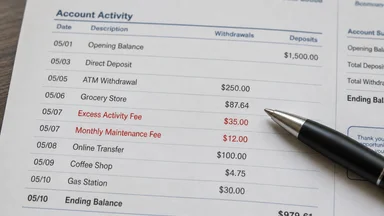
The shock is real. Consumer complaints filed with the Consumer Financial Protection Bureau (CFPB) routinely describe paying a statement balance in full, only to see a small interest charge appear the following month. The amounts are often modest — US$5 to US$20 — but the principle is corrosive. The advice to pay in full becomes conditional on never having carried a balance, a detail that is almost never communicated at the point of sale or in the monthly statement.
How Regulators Let the Trap Stay Set
The CARD Act of 2009 was a landmark consumer protection law that eliminated universal default, limited penalty fees, and required clearer disclosures. But it left residual interest untouched. The legislative history shows that early drafts included a provision requiring interest to stop accruing when a consumer pays the full balance shown on a statement. That provision was stripped out after industry opposition, according to congressional records cited by the National Consumer Law Center.
The CFPB has issued guidance on residual interest, but it stops short of a binding rule. In 2015, the bureau published a bulletin reminding issuers that advertising a grace period as “interest-free” could be misleading if residual interest routinely appears. The bulletin had no enforcement teeth. A 2024 proposed rule (CFPB Docket No. CFPB-2024-0012) that would have required real-time payoff quotes and banned interest on paid balances was circulated for comment but never moved to finalization, as of mid-2026.
Industry lobbying is a factor. The American Bankers Association and the Consumer Bankers Association have consistently argued that residual interest is a necessary part of the daily accrual system and that eliminating it would reduce the availability of grace periods for all consumers. The trade-off, they say, is that issuers would shorten grace periods or raise annual fees to compensate for lost revenue. Consumer advocates counter that the revenue at stake is roughly US$8 billion to US$12 billion annually, a sum that could be absorbed by the industry’s profit margins. For context, JPMorgan Chase alone reported net income of US$49 billion in 2024; the entire residual interest pool represents less than a quarter of that single bank's profit.
The regulatory stalemate leaves consumers in a game of whack-a-mole. Each new credit product — store cards, co-branded cards, subprime cards — adopts the same residual-interest language. The CFPB’s own consumer-education materials advise cardholders to “ask your issuer about trailing interest,” an instruction that essentially places the burden of understanding a deliberately opaque system on the individual.
The BNPL Twist: Same Trick, New Wrapper
Buy-now-pay-later providers such as Affirm, Klarna, and Afterpay have marketed themselves as transparent alternatives to credit cards. Their core pitch is clear: a fixed repayment schedule with no compounding interest. But the fine print reveals a similar timing trap. Deferred-interest products — often called “0% APR if paid in full within X days” — back-load the entire interest charge. If a consumer misses the deadline by even a day, interest is retroactively applied from the purchase date.
The Consumer Financial Protection Bureau found in a 2022 report that roughly 10% of BNPL users were charged late fees or deferred interest in a given year. For low-income borrowers, the rate was higher. The retroactive interest calculation means that a consumer who pays 90% of the balance on time still owes interest on the full original amount, not just the remaining portion. The structure mirrors the payday-loan rollover model: a small shortfall triggers a much larger charge.
BNPL contracts rarely include a grace period. Unlike credit cards, which by law must offer a minimum 21-day grace period on purchases if the consumer pays in full, BNPL products are structured as installment loans and are not subject to the same rules. Interest accrues from the moment of purchase, even if the consumer intends to pay early. The “0% APR” label applies only to the exact schedule; any deviation resets the calculation.
The result is that a consumer who uses BNPL for a US$200 coat and pays all four installments on time owes nothing extra. But a consumer who is one day late on the final installment may owe deferred interest on the full US$200, not just the missed US$50. The late fee is an additional charge on top. The combination can push the effective APR into triple digits, a dynamic that consumer advocates have called “payday lending in app form.” A 2023 study by the Center for Responsible Lending documented cases where BNPL deferred interest exceeded 100% APR on purchases as small as US$50.
Payday Lending’s Digital Cousin
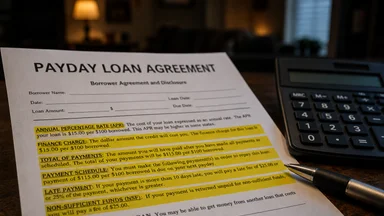
The payday-loan industry has long used a similar mechanism: a loan that renews automatically unless the borrower pays the full principal plus a fee. The fee is typically a flat dollar amount per US$100 borrowed, which translates to an APR of 300% to 500% for a two-week loan. When the borrower cannot repay in full, the lender offers a rollover — a new loan that covers the old one plus a new fee. The borrower pays interest on the original principal again, even though the principal has not been reduced.
Digital lenders have refined the model. Earned-wage-access apps such as Earnin and Dave offer advances on future paychecks, often with no stated interest rate. Instead, they charge “tips” or “express fees” that function as interest. The CFPB has classified some of these advances as loans, but state-level regulation is uneven. A borrower who takes a US$100 advance and repays it in two weeks might pay a US$5 tip, equivalent to a 130% APR. If the borrower cannot repay on time, the app may offer an extension — another fee, another round of interest on the same principal.
State rate ceilings are largely ineffective against these structures. Many states cap payday-loan APRs at 36% or lower, but lenders have shifted to online models or partnered with tribal entities to claim sovereign immunity. The result is a patchwork where a borrower in Texas can face a 600% APR while a borrower in New York is protected by a 25% cap. The digital nature of the products makes enforcement difficult.
The common thread across all three products — credit cards, BNPL, and payday loans — is that the consumer’s act of payment does not stop the interest clock. In each case, the fine print defines payment as insufficient unless it meets conditions that are not obvious at the point of transaction. The consumer who pays the amount they are shown still owes more.
Credit Reporting’s Silent Penalty
Residual interest has a second-order effect that is less discussed: it can trigger negative marks on credit reports. When a small residual interest charge appears on a statement that the consumer believed was at zero, the consumer may not pay it. After 30 days, the issuer reports the account as delinquent. A single missed payment can drop a FICO score by 50 to 100 points, depending on the starting score.
The credit scoring models treat the residual charge as a new balance, which can also increase credit utilization — the ratio of used credit to available credit. Utilization is the second most important factor in FICO scoring after payment history. A sudden spike from 0% to, say, 8% can lower a score by 10 to 20 points, even if the dollar amount is trivial. The score drop can last for months, because the utilization is calculated as an average over time.
Disputing a residual-interest charge is possible, but the process is tilted against the consumer. The Fair Credit Reporting Act requires credit bureaus to investigate disputes, but issuers have 30 days to respond, and they often simply verify that the charge was accurate. The consumer must prove that the charge was not owed, which requires deciphering the daily accrual calculation. Most consumers give up or do not notice the charge until after the 30-day window for disputing the statement has passed.
The credit reporting system thus magnifies the harm of a small fine-print trap. A US$5 residual interest charge can lead to a late payment notation, a utilization spike, and a score drop that affects the consumer’s ability to obtain a mortgage or auto loan for years. The lender bears no cost; the consumer bears the entire burden. This asymmetry is a design choice, not an accident.
What a Single Sentence in Legislation Would Fix
The regulatory fix is conceptually simple: require that interest stops accruing on the date the consumer submits a payment equal to the full balance shown on the statement. That single sentence would eliminate residual interest. It would also require issuers to provide real-time payoff quotes — the exact amount needed to bring the balance to zero on a given day — so that consumers do not have to guess.
A similar rule exists in the United Kingdom. The Financial Conduct Authority’s CONC rules require that lenders apply payments in a way that minimizes interest and that consumers can obtain a settlement figure at any time. UK credit card issuers must stop interest on a balance once the consumer pays the full statement amount. The result is not a collapse of the credit card market; UK issuers still profit, and grace periods remain widely available. A 2024 study by the UK Financial Conduct Authority found that over 95% of credit card holders enjoyed a grace period in the previous year, and card profitability remained stable.
Opponents argue that the UK system is not perfectly comparable because UK cards have higher annual fees and lower rewards. But the trade-off is a fair one: consumers get certainty that paying the statement balance ends interest accrual, and issuers can price that certainty into annual fees. The current US system hides the cost in fine print, making it impossible for consumers to comparison-shop on the basis of interest timing.
Another fix would ban retroactive interest on paid balances, the BNPL-style deferred-interest model. Legislation introduced in several states — California, New York, Illinois — would require BNPL lenders to calculate interest only on the unpaid portion of the purchase, not the full amount. None of these bills has passed as of mid-2026, but the model is gaining attention. The CFPB’s 2024 proposed rule included a similar provision, but it remains in limbo.
The simplest fix of all is to mandate that payments are applied to the highest-interest balances first, a rule that already exists for credit cards under the CARD Act but does not cover BNPL or payday loans. Extending that rule would prevent the common practice of applying payments to low-interest promotional balances while leaving high-interest cash advances untouched. The technology to do this is trivial; the will to mandate it is not.
The Revisionist Take: Paying Your Balance in Full Is Not Enough
The advice to pay your credit card balance in full every month is not wrong, but it is incomplete. It assumes that the act of paying the statement balance resets the interest clock. For a consumer who has never carried a balance, that assumption holds. For a consumer who carried a balance in the prior month — even a single cent — the assumption fails. The advice should be: pay your statement balance in full, and then pay any residual interest that appears on the next statement. Or, more practically, consider contacting your issuer to request a payoff quote before making a final payment.
The burden of this complexity falls disproportionately on low-income consumers, who are more likely to carry balances and more likely to be caught in the residual-interest trap. A 2023 study by the Consumer Federation of America found that households earning under US$40,000 per year were three times as likely to report an unexpected interest charge as households earning over US$100,000. The trap deepens existing inequality.
The revisionist take is not that paying in full is bad advice. It is that the advice is only effective when paired with an understanding of the fine print. And the fine print is deliberately obscure. The lenders who design these products know that most consumers will never read the cardholder agreement, and that those who do will not catch the daily-accrual interaction. The system profits from that ignorance.
A regulatory fix is the only clean path forward. Until then, consumers should be aware that paying off a debt may require multiple steps: pay the statement balance, check the next statement for residual interest, pay that too, and then wait another month to confirm the balance is truly zero. The alternative is to accept that the interest clock may not stop — it just slows down.
This article is for informational purposes only and does not constitute financial, legal, or regulatory advice. It describes general industry practices and should not be taken as personalized guidance.